I didn't exactly win, but I found real ways to stretch the plan, and learned the hard way that trying to save tokens on a smaller model costs more in the end.

The moment the work stops: locked out mid-task with the weekly budget already gone.
Building the site, hitting the wall
I work in Claude Code all day across several projects at once.
A few weeks ago I was building out my website, and I needed to get the product pages finished.
I set up a guided walkthrough for each product so a visitor can click through and see exactly how it works, plus a live demo they can try right there on the page.
Building out a complete site with interactive elements eats tokens fast.
I ran several terminal windows side by side, with each one building a different piece of the site at the same time.
I was on the $200.00 Max plan during the build because running that many active windows at once requires a larger budget.
Once the site was finished, I dropped back down to the $100.00 max plan.
Then on Saturday, I hit the wall.
It wasn't the five-hour window limit.
I had drained my entire weekly allowance.
I was locked out with two choices: wait twenty-four hours, or pay extra to keep going.
I decide when the clock starts
The limit doesn't work like a standard phone data plan where you get one bucket of usage for the day.
It runs on a rolling five-hour window, and that window starts the moment I send my first message.
I get a set budget to spend inside those five hours, and if I burn through it early I'm paused until the window resets.
The reset comes exactly five hours after that first message, not at midnight and not on any schedule Anthropic controls.
So the one thing that dictates the rhythm of my entire day is when I send that first message.
The early ping doesn't buy me more time. It just moves my downtime off the middle of my workday.
It's like starting the dishwasher before I leave the house instead of when I walk back in. Same machine, same load, same run time. I just line up the part where I can't use it with the hours I'm away anyway.

The same workday, two ways. Same budget, same 11:30 burnout. The early ping just moves the lockout off the middle of the day. Tap to enlarge.
Same budget. Same 11:30 burnout. The only thing that moved is when the lockout lands.
By choosing when the clock starts, I choose when my fresh windows arrive.
I line them up so the lockouts fall over lunch or after I've stopped for the day, instead of right in the middle of a working session.
So I set up a cron job to send Claude one small message a couple of hours before I plan to start.
That one ping opens my window early and aligns my resets for the rest of the day before I even sit down at my desk.
When I know my window resets at noon and again at five, I can plan my whole schedule around it.
The early ping fixes when my windows open, but it does nothing about how fast I burn through them.
I still ran out of tokens on Saturday.
To fix that part, I needed to make each session leaner.
The heavy cost of a long conversation
I learned how context windows actually work on the very first blog post I wrote with Claude.
We went back and forth on a draft for a while, and suddenly my tokens were completely gone - on the $200.00 a month plan that comes with 20X usage!
Every time you send a message, Claude re-reads the entire conversation up to that point.
It doesn't just read your new sentence.
Writing a blog post is nothing but back and forth.
By the tenth pass, every message is paying the token price of reading the nine that came before it.
The first thing I changed was handing the heavy drafting off to Gemini, so the back-and-forth never touches my Claude budget at all.
That helped, but a long coding session runs into the same wall.
The conversation keeps growing, and every message costs more than the last.
My only way to reset the cost was to shut the whole session down with my end-conversation routine, which takes about ten minutes to save everything.
I wanted a way to reset in the middle of a session without losing my momentum.
I spun up a team of independent Claude agents and asked them to find a faster way to clear the board, which is a story I am saving for its own post.
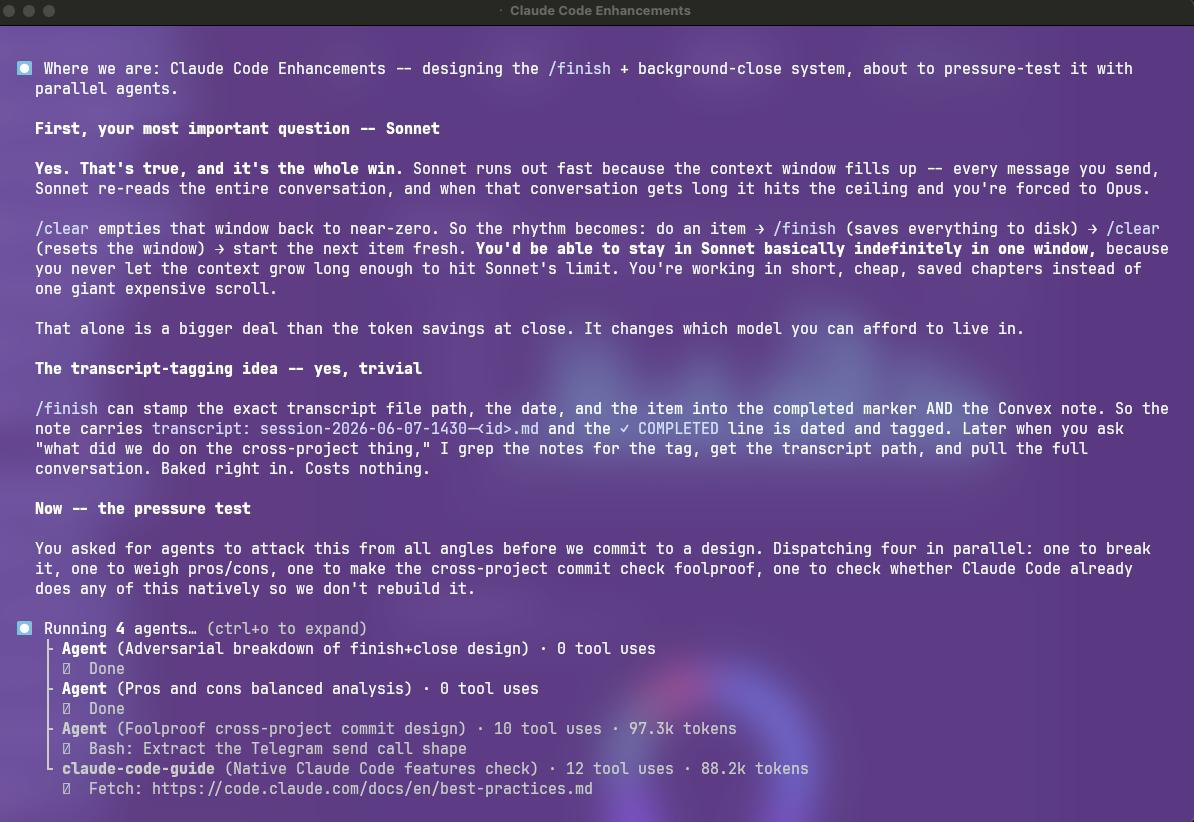
Four agents working the same problem in parallel. That story is for another post.
They came back with two commands that changed how I work.
/clear is built into Claude, and it wipes the conversation back down to a clean slate so the next task starts cheap.
/finish is a command I built myself as a safety net before I clear.
It confirms every piece of work across every project folder is saved and backed up automatically.
Now my rhythm is to do a task, type /finish to lock everything in, type /clear to reset the window, and start the next task fresh.
I work in short saved chapters instead of one giant expensive scroll.
What clearing actually saves
The first time I used this combination, I watched my context drop from seventy-three percent (in opus) to zero in a single keystroke.
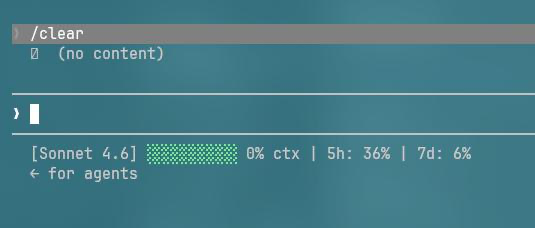
Right after I run /clear, the context bar drops to 0% used.
All that accumulated back-and-forth that was making every message expensive disappeared from the window.
When I sent my next message, a fresh briefing loaded and the context settled back around thirty-eight percent in Sonnet.
My goal was tokens and Sonnet uses far less.
If I was under 40% context usage in Sonnet every time I used the /clear skill, it would allow me to work in Sonnet for longer periods.
I get to reclaim that space every single time I finish a task.
I originally assumed /clear took me completely back to zero tokens, but a small fixed baseline reloads every time.
That baseline holds the instructions and memory files that make Claude useful for my specific projects.
Measured on my own setup, that baseline is roughly 25,000 tokens.
A long working session easily climbs past 100,000 tokens, so clearing drops me from over 100,000 back down to 25,000.
| Situation | Roughly what it costs per message |
|---|---|
Fresh window (or just after /clear) |
~25,000 tokens of baseline |
| A long session that has run for an hour-plus | 100,000+ tokens, and climbing every message |
The only way to shrink that baseline cost is to keep my own instructions file lean.
A fat instructions file costs tokens all day because it reloads on every single message.
Keeping those files clean is a separate project I will write up on its own.
The hidden cost of the smaller model
Because clearing kept every session short, I could stay under Sonnet's smaller limit and run the cheaper model all day long.
So that is exactly what I did.
I finished each task, cleared the board, and kept working in Sonnet to save tokens.
And within a day I was right back to yelling at my monitor.
Claude could not follow what I was asking.
It missed things, it went in circles, and it felt like the tool had gotten dumber overnight.
I was certain Anthropic had broken something in an update.
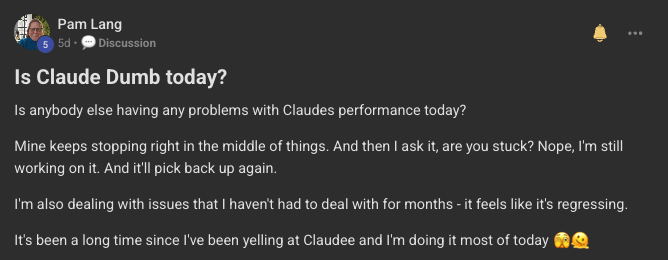
A post I put up in one of my user groups that day, when I was sure something was wrong with Claude.
Nothing was broken.
I was just working in Sonnet instead of Opus.
The moment I switched back to the more powerful model, all of that friction disappeared.
That was the hidden cost.
Sonnet is cheaper by the token, but the hours I lost fighting a model that could not keep up cost me far more than I ever saved.
It reminded me of a friend who went through a divorce.
She hired a general attorney to keep the hourly rate down.
Every time she called with a question, he had to research it and call her back, and the billed hours piled up.
She finally switched to a divorce attorney, asked the same kind of question, and got her answer right on the phone in five minutes.
The lower hourly rate turned out to be the far more expensive choice.
That is Opus and Sonnet for my work.
I will keep clearing my context to save tokens, but the model itself is the one place I stopped cutting corners.
Stretching the plan
These three moves stacked together stretch the smaller plan a lot further.
- Open the window early with a morning ping, so the reset lands inside the working day.
- Work in saved chapters with
/finishthen/clear, so the conversation never grows expensive. - Stay on the powerful model, because dropping down costs more in wasted time than it saves in tokens.
I thought these moves would keep me on the standard plan for good once the heavy website build was done.
I'm writing this on a Monday night, barely eighteen hours into a fresh weekly window, and I'm already at thirty-four percent capacity.
The only way I'd stay under the limit is to work on one project at a time.
That isn't going to happen.
I always have other things I want to build.
The strategies I put in place work beautifully for managing context and extending the hours I can work, but I still need the more costly $200.00 plan when I want to build at full speed, with several projects running at once.