
In 2023, I spent an entire day building a suite of custom GPTs for business analysis.
They took stakeholder interview transcripts and turned them into structured deliverables:
- current state
- future state
- pain points
- KPIs
- user stories
The whole pipeline.
They were some of the first custom GPTs I ever built, and they worked beautifully.
That was almost three years ago.
Today, I wouldn't build custom GPTs. I would build a workflow or an app that does the same job, but faster and better.
What I built then was good. Still useful two years ago. Still relevant a year ago.
Technology was moving quickly, but the things you built had time to earn their keep.
That pace has changed.
The shelf life is shorter now, and it keeps getting shorter.
I have watched this happen before.
When I was teaching web design, WYSIWYGs (what you see is what you get) were just hitting the market.
What you used to hand-code line by line, you could suddenly drag and drop. It opened the door for people who didn't know coding to build their own websites.
Something similar is happening now, except faster.
Writing custom logic, building AI pipelines, connecting tools together - things that used to require real coding or complex platforms to wire up - you can now just describe out loud.
Tell it what you want. It builds. Adjust as you go.
It's referred to as vibe coding.
Six or eight months ago it was clunky at best. Today, your imagination is the only thing holding you back.
That Is Not a Problem. That Is the Opportunity.
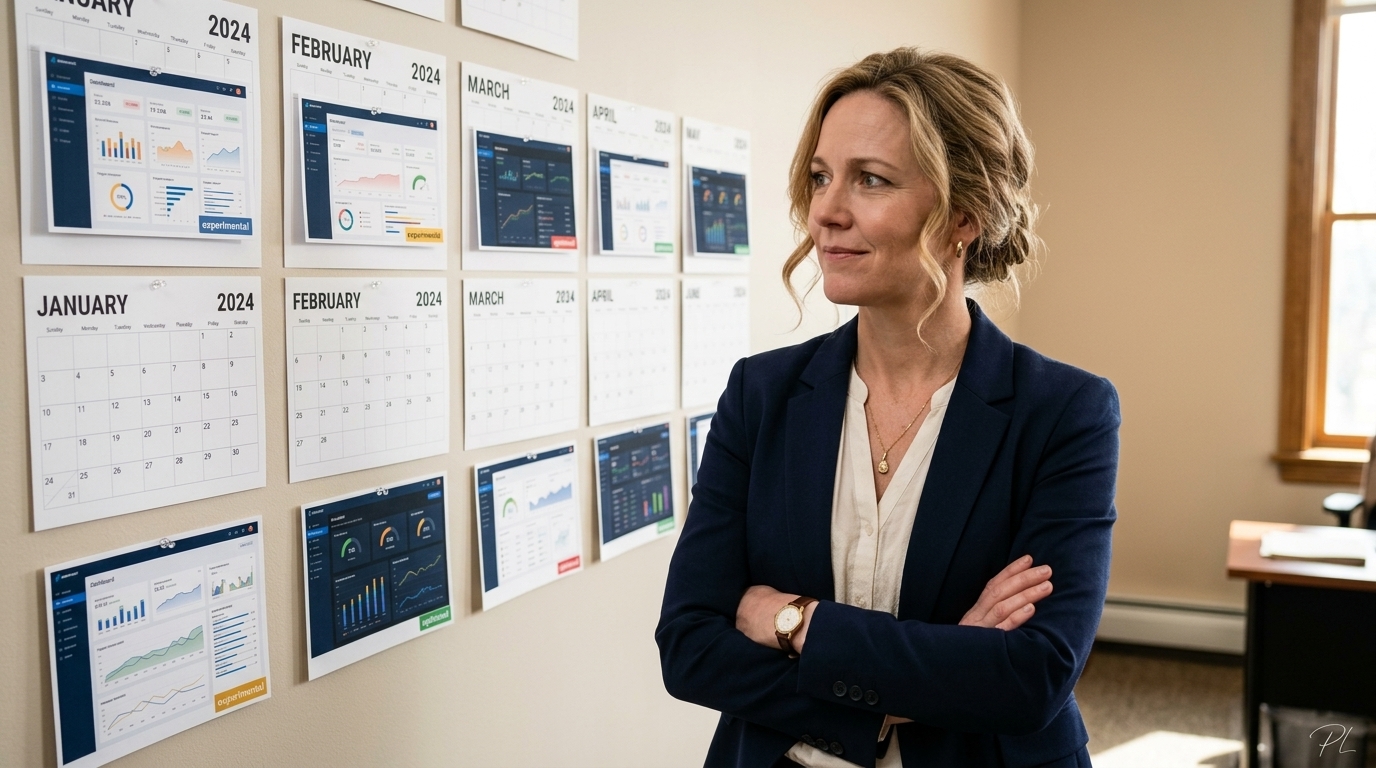
Some companies treat AI implementation like a software install.
Scope it, budget it, roll it out, check the box. Done.
That model worked for CRM systems that looked the same year to year.
I know, because I trained teams on a $50 million CRM rollout that barely changed between updates.
You could train a team in January and it still applied in December.
AI does not work that way.
In the last twelve months, the tools I use daily have changed significantly.
- Features that did not exist six months ago are now central to how I work.
- The model I relied on in January got replaced by something better in March.
- A workflow I built in February had a faster path by April.
This is not unusual. This is the pace.
I watched this play out in real time this spring.
An Instructor in one of my AI communities, Mark Kashef, had built a Claude Code course in Q4 of 2025 and was completely overhauling it in March because of all the changes that had taken place in the 6 months since launching that course.
He had an anticipated launch date of March 31st for the updated course.
Anthropic went in overdrive for upgrades, they weren't small, and it hasn't stopped since.
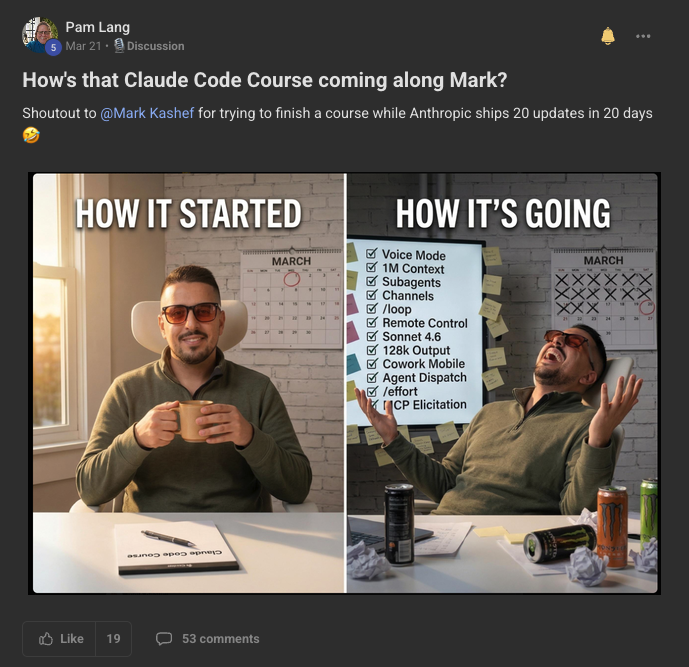
This is an actual post I made in our Early AI-dopters community.
I really felt bad for Mark. He works so hard on the materials he puts out for us. That first course lasted six months before he needed to remake it. By March, he couldn't even get one module out before it was outdated.
That's the pace we're working at today.
There is so much competition between these AI companies trying to outpace each other that the updates are impossible to keep up with if you're not paying attention.
And here is the part that's easy to miss: that pace is not exhausting, it's compounding.
Every time the tools improve, the things we can build with them get more powerful.
The day I spent building those first custom GPTs taught me patterns I still use.
The difference is that now I can apply those patterns in a fraction of the time, to harder problems, with better results.
Why "Set It and Forget It" Leaves Money on the Table
AI is not an IT project you hand to one department.
It touches sales, operations, training, customer service, content, scheduling, reporting.
Every team that handles information, which is every team, can benefit.
But each team needs someone who understands their specific work AND understands what AI can do right now.
Not what it could do theoretically. What it can do today, with the tools that exist today.
Consider what happens when nobody is watching.
A team sets up an AI workflow in January. It works. They use it every day. Six months later, the same task could be done in half the steps because the underlying model improved.
But nobody told them. Nobody checked.
They are still running the January version, getting January results, while the tools have moved on.
That is not a technology failure. That is a gap in the implementation model. The "project" ended. The capability did not keep up.
What Ongoing AI Capability Actually Looks Like
The companies that will pull ahead are not the ones with the best initial setup.
They are the ones who treat AI as a living capability that someone is actively maintaining.
Someone keeping an eye on what the team uses and is up to date on what the tools can do now and flags what could be better.
Businesses need a practitioner, not a consultant who read the white paper.
The person training your team needs to be using AI tools themselves, every day.
They need to keep up on:
- what just shipped
- what broke
- what got better
- what is coming next
And they need to conduct training that builds ownership, not dependency.
It's important to get your team on board because they're the ones using these systems and tools.
They need to understand what's possible.
This enables them to spot streamlined opportunities themselves, to say "wait, there might be a faster way to do this now".
The goal is for the team to own it.
This only happens when training builds confidence, not just compliance.

Teach the Pattern, Not Just the Tool
The tools change every few months, but the pattern of finding repetitive work and compressing it with AI does not.
That's the thing worth teaching.
Not "here is how to use this specific feature." That will be outdated in a quarter.
Instead: here is how to look at your daily work, find the parts that repeat, and ask whether AI can compress them.
A team that understands the pattern does not wait for someone to come check whether their workflow is still current.
They get more self-sufficient over time, not less.
That is the compounding effect.
That is why this is an opportunity, not a burden.
The companies that treat AI as a one-time project will get one round of efficiency gains and then plateau.
The ones that treat it as an ongoing capability will compound those gains quarter over quarter.
Same technology. Different results.
The difference is not the tools. It is whether someone is paying attention and knows what to look for.
If This Sounds Like Your Team
The pattern is the same in every organization.
The technology is ready.
The people need someone who genuinely uses these tools every day, understands how systems fit together, and can show your team how AI fits into the work they already do.
That is what I do.
If that is what your organization needs right now, I would love to help.