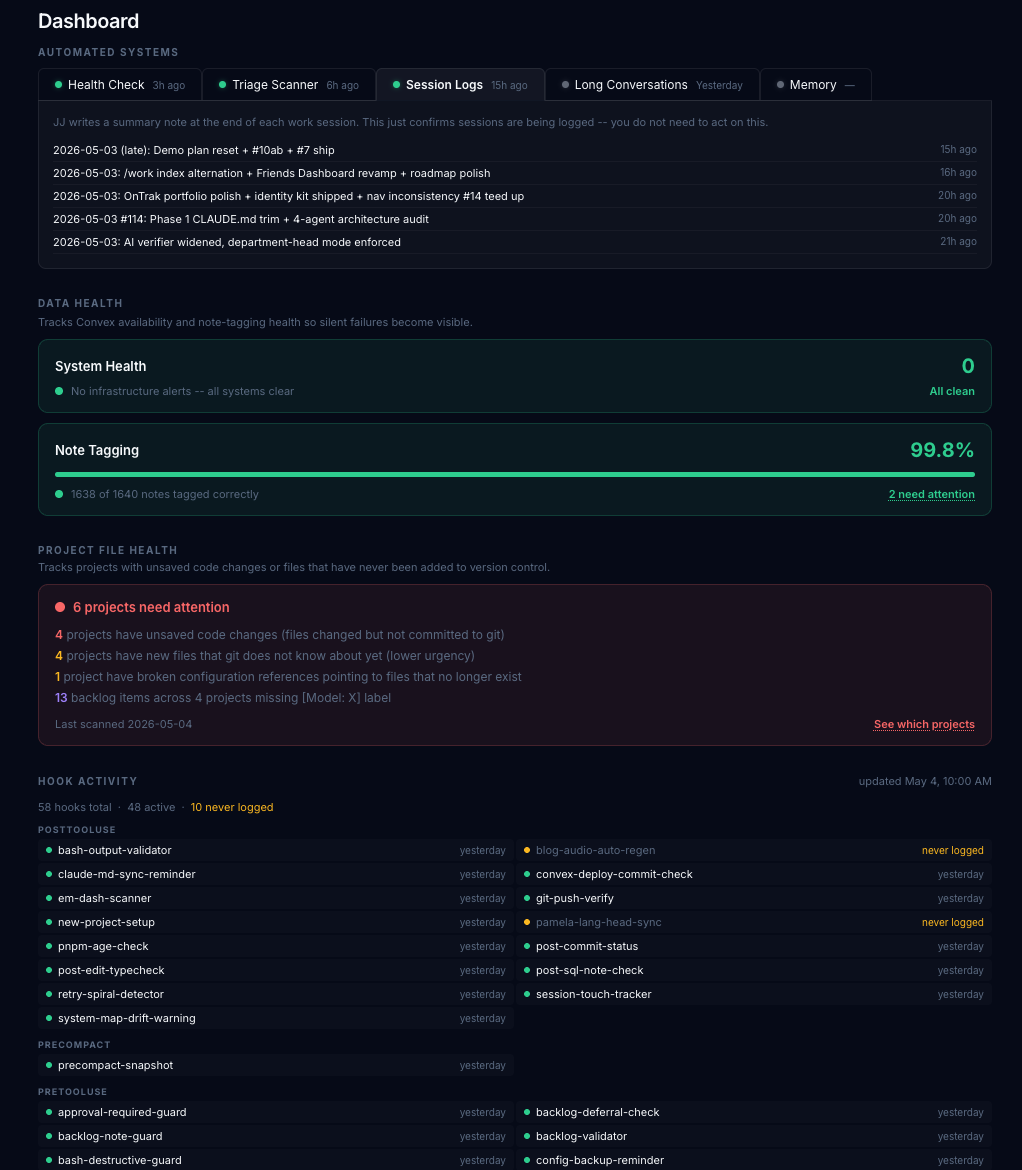
Life at a Glance pulls data from Convex, git, the Claude Code hook layer, and the file system. It doesn't store state of its own. It reads the real state of everything already running and puts it in one place.
📋
Backlog and project health
Every open backlog item across every project, with staleness flags. Items that haven't moved in 30 days show up with a warning before they become invisible.
🔗
Hook activity panel
The Claude Code hook layer runs 40+ scripts on every tool call. The dashboard shows recent hook fires, blocks, and silent failures so nothing disappears into the logs unnoticed.
🗒️
Session logs and notes
Every Claude Code session writes a structured note to Convex. The dashboard surfaces the most recent ones by project so I can see what was worked on and what was left open.
🗂️
System map drift
I maintain a map of every hook, skill, rule, and memory file in my setup. When something is added or changed without the map being updated, the drift shows up here.
🏷️
Note tagging accuracy
Convex notes are the long-term memory for the whole setup. Poorly tagged notes become unfindable. The dashboard flags notes that are missing required tags before they get buried.
📁
Project file health
Uncommitted changes, untracked files sitting for days, branches that haven't been pushed. The kinds of drift that accumulate quietly across five repos running in parallel.